Queer Places:
1749 Coliseum St, New Orleans, LA 70130, USA
Metairie Cemetery, 5100 Pontchartrain Blvd, New Orleans, LA 70124, United States
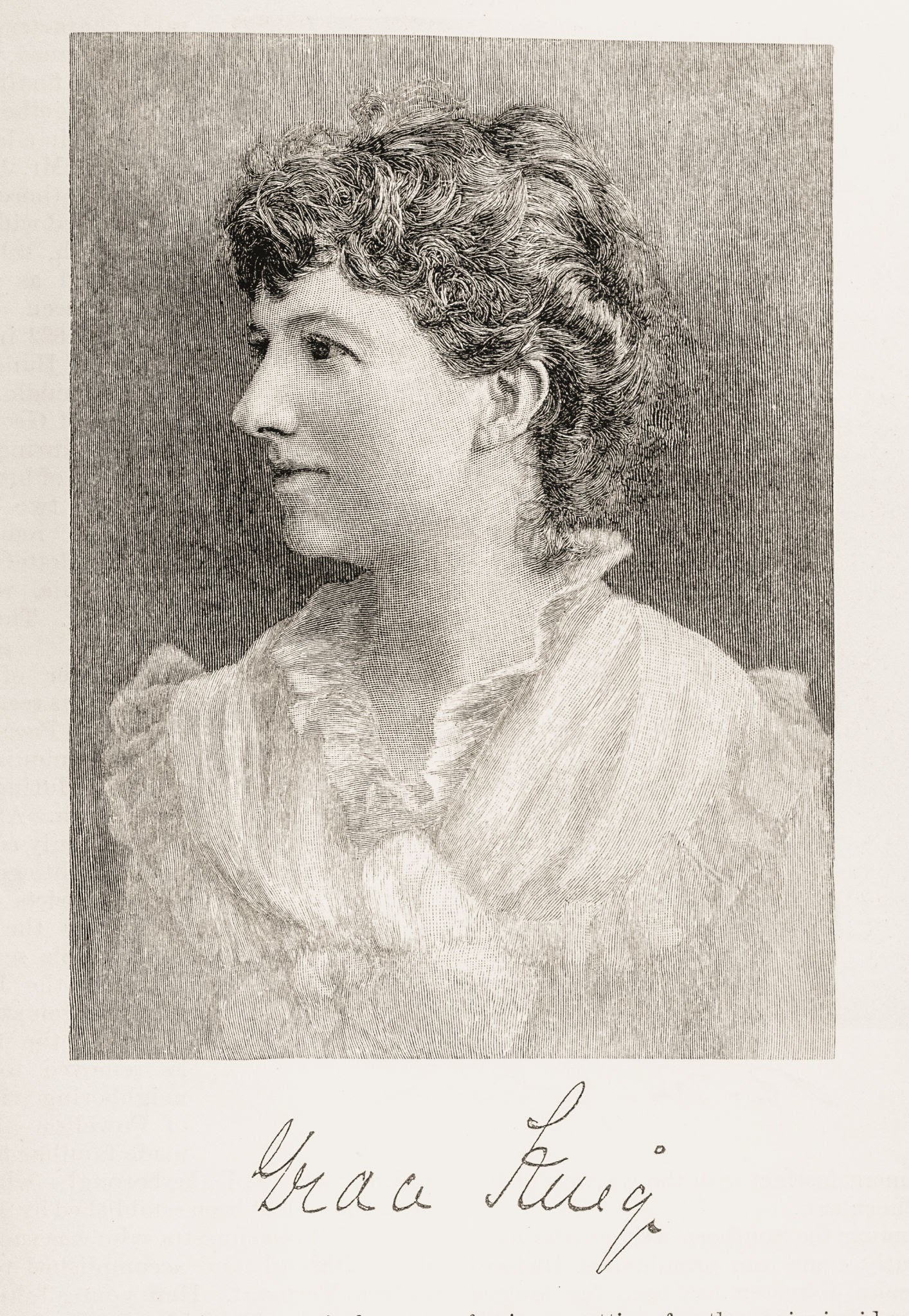 Grace Elizabeth King (November 29, 1851 – January 14, 1932) was a foundational American author, historian, and cultural matriarch of New Orleans. Celebrated as a leading
voice of late 19th-century "local color" literature, King elevated Southern women’s perspectives, preserved regional history, and nurtured generations of writers as the
premier salonnière of the French Quarter.
Grace Elizabeth King (November 29, 1851 – January 14, 1932) was a foundational American author, historian, and cultural matriarch of New Orleans. Celebrated as a leading
voice of late 19th-century "local color" literature, King elevated Southern women’s perspectives, preserved regional history, and nurtured generations of writers as the
premier salonnière of the French Quarter.
Born into a prominent, wealthy New Orleans family, King's childhood was abruptly upended by the Civil War. When Union troops occupied New Orleans in 1862, her family fled
to their central Louisiana sugar plantation.
Although her family was Scotch-Irish Presbyterian, they socialized heavily within elite French Creole circles. After the war, King attended French-speaking Catholic
convent schools in New Orleans, mastering French and absorbing the distinct cultural traditions of Creole society—a background that became the core backdrop of her life's
work.
King began her literary career out of defiance. In 1884, Northern editor Richard Watson Gilder challenged her to counter George Washington Cable’s critical, satirical
portrayals of Louisiana Creoles. In response, she penned her debut novella, Monsieur Motte (1886), establishing her signature style:
Her short stories and novels—including Tales of a Time and Place (1892) and Balcony Stories (1893)—examined the post-war hardships faced by Southern women across racial
and class lines.
Rather than focusing on grand military maneuvers, King centered domestic spaces, female resilience, and silent interior struggles during Reconstruction.
Beyond fiction, King established herself as Louisiana's premier historian. Mentored by historian Charles Gayarré, she favored a romantic, impressionistic, and empathetic
approach to historical narration—often characterized as a "no-fault" history that sought to harmonize conflicting cultural legacies:
In works like New Orleans: The Place and the People (1895) and Creole Families of New Orleans (1921), she argued that true history lives just as much in old lace,
brocade, jewelry, and domestic artifacts as in official archives.
As an active officer in the Louisiana Historical Society, King led early conservation efforts to safeguard the architectural and cultural integrity of the French
Quarter.
During the 1920s, King’s home on Coliseum Street became the intellectual heartbeat of New Orleans. Acting as the city’s undisputed grand dame of letters, she hosted a
celebrated weekly salon that bridged the older Gilded Age aristocracy with early modernist figures:
She hosted and mentored burgeoning writers who flocked to the cheap rents of the French Quarter, including
Sherwood Anderson, Lyle Saxon, and
William Faulkner.
She maintained vibrant lifelong correspondences with major literary figures across the nation, including Mark Twain and
Charles Dudley Warner.
While King operated within the socially conservative constraints of the turn-of-the-century American South, modern queer studies, feminist literary scholars, and
historians highlight several key aspects of her life and social network:
"I have never felt the necessity for marriage; I have never seen a man I would be willing to submit to." — Grace King.
King explicitly chose to remain single throughout her 80 years. In an era where marriage was the primary economic path for women, King viewed romantic dependency on men
as an obstacle to intellectual and creative autonomy.
After her father's death, King lived in a non-patriarchal household comprised entirely of women—her mother, her sisters (Annie and Nan), and female companions—creating an
intentional community of financial, creative, and emotional support.
King was an active member of Julia Ward Howe’s pan-female literary circle, the Pan Gnostics, in the mid-1880s. Her journals
and letters record deep, emotionally passionate bonds ("romantic friendships") with women intellectuals across New England and Louisiana.
Contemporary literary scholars analyze King’s depictions of female intimacy, non-traditional household structures, and subversion of standard Victorian gender roles as
vital precursors to 20th-century queer and feminist literature.
The non-patriarchal, all-female household at 1749 Coliseum Street (and earlier family residences) was built around Grace Elizabeth King, her family members, and a close
network of female companions, lived-in partners, and long-term domestic partners.
The specific women who formed this domestic unit and key female companions included:
Sarah Ann Miller King: Grace's mother, who remained the matriarch of the home until her death.
Annie Ragan King ("Nan"): Grace’s unmarried sister, life companion, and closest intellectual confidante. Nan traveled extensively with Grace throughout Europe, co-hosted the
Coliseum Street salon, and managed the domestic affairs of the household.
Nina King: Grace’s younger sister, who lived in the family household for much of her life and contributed to its daily operation and domestic upkeep.
May King McDowell: Grace's sister who, while married, frequently spent extended periods living at or recovering in the family's woman-centered residences alongside her
sisters.
Outside of her immediate family, King maintained lifelong, emotionally intimate relationships—referred to in 19th-century terms as "romantic friendships"—with prominent
female intellectuals, artists, and literary patrons who either stayed as long-term houseguests or formed part of her intimate domestic circle:
Marie-Thérèse Blanc (penned under Th. Bentzon): A prominent French literary critic, novelist, and traveler. Blanc and King formed a deep, passionate bond; King stayed
with Blanc for extended periods in France, and Blanc visited and stayed with the King women in New Orleans, helping champion King's works in European journals.
Julia Ward Howe: The prominent abolitionist, poet, and feminist leader. King spent long periods staying with Howe and her daughters (such as Maud Howe) in Rhode Island
and Boston. Howe's pan-female literary circle (The Pan Gnostics) served as a major social model for King's own woman-centered household and salon back in Louisiana.
Annie Adams Fields: A prominent Boston author, social reformer, and salonnière who lived in a famed "Boston marriage" with
author Sarah Orne Jewett. Fields became a close confidante and host to Grace and Nan King during their northern travels.
Baroness Marie Blaze de Bury: A Franco-Scottish writer and intellectual with whom Grace and Nan maintained long-term personal ties, frequently residing together during
their European sojourns.
In 1926 Pelican Bookshop Press, New Orleans, published "William Spratling and William Faulkner, Sherwood Anderson and Other Famous Creoles: A Gallery of Contemporary New Orleans",
issued in 250 copies. The “Famous Creoles” (with ages in 1926) were
- Conrad Albrizio, 27, New York-born, serious artist, Spratling’s neighbor, Arts and Crafts Club stalwart
- Sherwood Anderson, 50, “Lion of the Latin Quarter,” eminence gris, generous to respectful younger writers (LGBTQ friendly)
- Marc Antony and Lucille Godchaux Antony, both 28, Love-match between heiress and lower-middle-class boy, local artists
- Hamilton “Ham” Basso, 22, Star-struck recent Tulane grad, aspiring writer, good dancer (LGBTQ friendly)
- Charles “Uncle Charlie” Bein, 35, Director of Arts and Crafts Club’s art school; lived with mother, sister, and aunt (GAY)
- Frans Blom, 33, Danish archeologist of Maya, Tulane professor, colorful resident of Quarter
- Roark Bradford, 30, Newspaperman, jokester, hit pay dirt with Negro dialect stories
- Nathaniel Cortlandt Curtis, 45, Tulane architecture professor, preservationist, recorded old buildings
- Albert Bledsoe Dinwiddie, 55, President of Tulane, Presbyterian
- Marian Draper, 20, Ziegfeld Follies alum, Tulane cheerleader, prize-winning architecture student
- Caroline “Carrie” Wogan Durieux, 30, Genuine Creole, talented artist living in Cuba and Mexico, painted by Rivera
- William “Bill” Faulkner, 29, Needs no introduction, but wrote the one to Famous Creoles (LGBTQ friendly)
- Flo Field, 50, French Quarter guide, ex-journalist, sometime playwright, single mother
- Louis Andrews Fischer, 25, Gender-bending Mardi Gras designer, named for her father (LGBTQ friendly)
- Meigs O. Frost, 44, Reporter’s reporter; lived in Quarter; covered crime, revolutions, and arts
- Samuel Louis “Sam” Gilmore, 27, Greenery-yallery poet and playwright, from prominent family (GAY)
- Moise Goldstein, 44, Versatile and successful architect, preservationist, active in Arts and Crafts Club
- Weeks Hall, 32, Master of and slave to Shadows-on-the-Teche plantation, painter, deeply strange (GAY)
- Ronald Hargrave, 44, Painter from Illinois formerly active in Quarter art scene, relocated to Majorca
- R. Emmet Kennedy, 49, Working-class Irish boy, collected and performed Negro songs and stories
- Grace King, 74, Grande dame of local color literature and no-fault history, salonnière
- Alberta Kinsey, 51, Quaker spinster, Quarter pioneer, indefatigable painter of courtyards
- Richard Ray Kirk, 49, Tulane English professor and poet, loyal Michigan Wolverine alumnus
- Oliver La Farge, 25, New England Brahmin, Tulane anthropologist and fiction-writer, liked a party
- Harold Levy, 32, Musician who ran family’s box factory, knew everybody, turned up everywhere
- Lillian Friend Marcus, 35, Young widow from wealthy family, angel and manager of Double Dealer (LGBTQ friendly)
- John “Jack” McClure, 33, Poet, newspaper columnist and reviewer, Double Dealer editor, bookshop owner
- Virginia Parker Nagle, 29, Promising artist, governor’s niece, Arts and Crafts Club teacher
- Louise Jonas “Mother” Nixon, 70, A founder of Le Petit Theatre and its president-for-life, well-connected widow
- William C. “Cicero” Odiorne, 45, Louche photographer, Famous Creoles’ Paris contact (GAY)
- Frederick “Freddie” Oechsner, 24, Recent Tulane graduate, ambitious cub reporter, amateur actor
- Genevieve “Jenny” Pitot, 25, Old-family Creole, classical pianist living in New York, party girl
- Lyle Saxon, 35, Journalist, raconteur, bon vivant, host, preservationist, bachelor (GAY)
- Helen Pitkin Schertz, 56, Clubwoman, civic activist, French Quarter guide, writer, harpist
- Natalie Scott, 36, Journalist, equestrian, real-estate investor, Junior Leaguer, social organizer (LGBTQ friendly)
- William “Bill” Spratling, 25, Famous Creoles illustrator, Tulane teacher, lynchpin of Quarter social life (GAY)
- Keith Temple, 27, Australian editorial cartoonist, artist, sometimes pretended to be a bishop
- Fanny Craig Ventadour, 29, Painter, Arts and Crafts Club regular, lately married and living in France
- Elizebeth Werlein, 39, Suffragette with colorful past, crusading preservationist, businessman’s widow
- Joseph Woodson “Pops” Whitesell, 50, Photographic jack-of-all-trades, French Quarter eccentric, inventor (GAY)
- Daniel “Dan” Whitney, 32, Arts and Crafts Club teacher, married (two) students, beauty pageant judge
- Ellsworth Woodward, 65, Artistic elder statesman, old-fashioned founder of Newcomb art department
References:
Other references:
- Bush, Robert. Grace King: A Southern Destiny (Baton Rouge: Louisiana State University Press, 1983).
- Bush, Robert (Ed.). Grace King of New Orleans: A Selection of Her Writings (Baton Rouge: Louisiana State University Press, 1973).
- Taylor, Helen. Gender, Race, and Region in the Writings of Grace King, Ruth McEnery Stuart, and Kate Chopin (Baton Rouge: Louisiana State University Press, 1989).
- Jones, Anne Goodwyn. Tomorrow Is Another Day: The Woman Writer in the South, 1859–1936 (Baton Rouge: Louisiana State University Press, 1981).
- Griswold, Wendy, and Michelson, Ethan. "The Outsider's Edge: Geography, Gender, and Sexuality in the Local Color Movement" (Sociology/Literary Analysis).
- Juncker, Clara. "Grace King: Feminist, Southern Style." The Southern Quarterly 26, no. 3 (1988): 15–30.
- Nagel, James. "Grace King and the Cultural Background of Balcony Stories." In Race and Culture in New Orleans Stories (Tuscaloosa: University of Alabama Press, 2014): 58–83.
- Wilson, Mary Ann. "Grace King: Southern Self-Representation and Northern Publisher." In Popular Nineteenth-Century American Women Writers and the Literary Marketplace (2007): 388–403.
- King, Grace. Memories of a Southern Woman of Letters (Macmillan, 1932).
- Grace King Selected Papers (Mss. 1282). LSU Libraries Special Collections, Baton Rouge, LA.
- Grace King Papers. Southern Historical Collection, University of North Carolina at Chapel Hill.
Support this project
This website is a passion project researched, developed, and funded entirely by me. If you find the content valuable and would like to help support the ongoing research and hosting costs, any contribution is deeply appreciated.
Thank you for keeping this independent resource alive!
My books on Amazon: Elisa Rolle's books
BACK TO HOME PAGE
